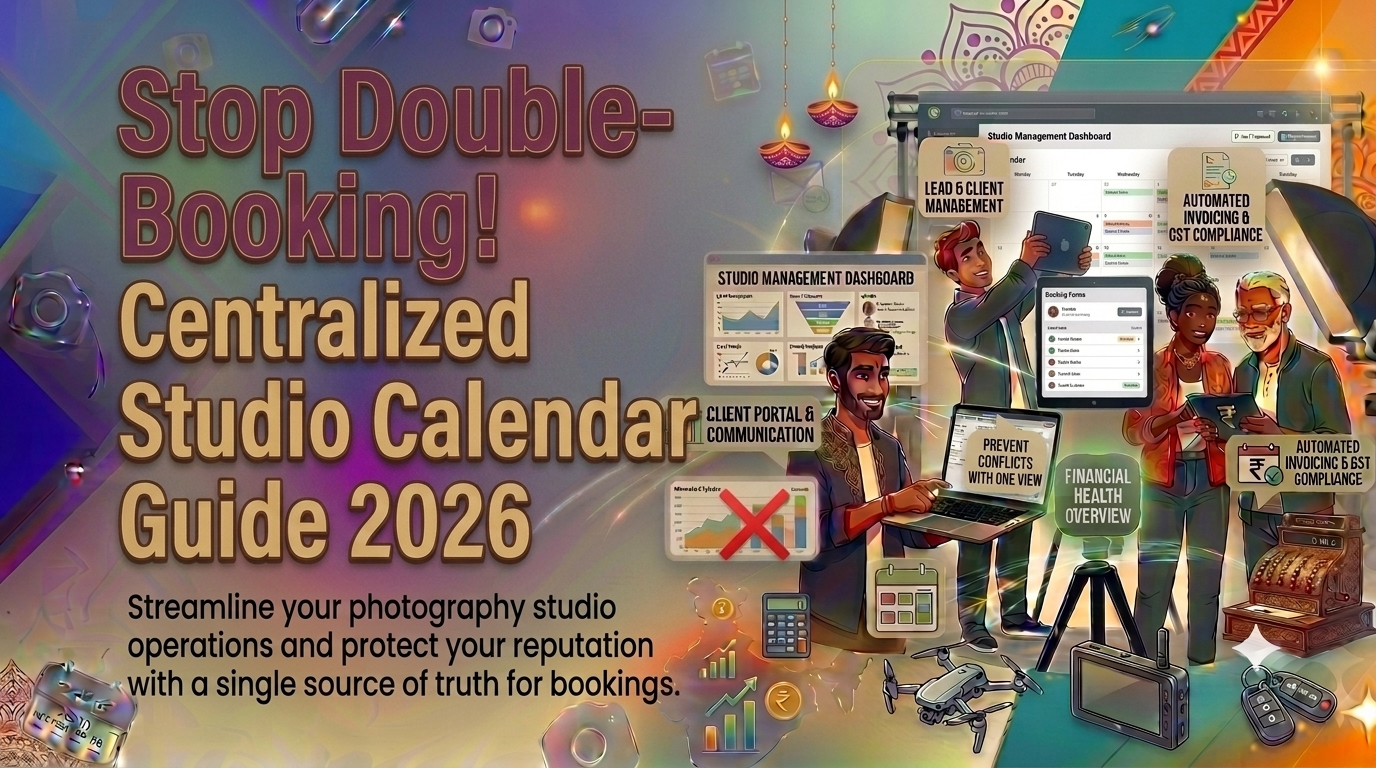
Stop Double-Booking! Centralized Studio Calendar Guide 2026
The Critical Risk of Scheduling Conflicts in Photography Studios
In the premium creative landscape of modern India, a professional photography brand is built entirely upon trust, pristine execution, and flawless reliability. However, as independent operations scale up into full-fledged corporate entities, creative entrepreneurs inevitably encounter severe operational friction. Among these systemic obstacles, few issues are as instantly devastating as booking errors. If you do not actively manage your schedule through a single source of truth, you risk severe operational distress. To protect your brand, you must learn how to stop double-booking your high-value production dates, or face rapid loss of market position.
Imagine the peak wedding season in India—an intense, multi-day period packed with concurrent events across various geographic regions. A prominent studio based in Pune accidentally logs two high-budget celebrity weddings for the exact same Muhurat slot on a Sunday evening. The error is only discovered forty-eight hours prior to the main event, triggered by a frantic WhatsApp confirmation message from one of the brides. Panic ensues. Senior cinematographers are already deployed, top-tier mirrorless gear is completely checked out, and the studio owner is left with an agonizing dilemma: breach one contract or compromise the quality of both by scrambling to find sub-par freelance replacements at the last minute. This chaotic scenario happens daily across thousands of creative businesses that rely on distributed post-it notes, personal text chains, and fragmented paper diaries.
The core vulnerability lies in the structural separation of modern booking pipelines. Inquiries pour in from multiple lead channels simultaneously: Instagram direct messages, official corporate emails, WhatsApp Business chats, face-to-face studio consultations, and website forms. When these disparate pipelines feed into separate, disconnected tracking repositories, an organizational blind spot forms. A verbal commitment made by a sales executive during an on-site consultation in Surat might not reflect on the master spreadsheet managed by the production crew in Ahmedabad. This disconnect forms a breeding ground for catastrophic scheduling overlaps that immediately threaten your business continuity.
The Psychological and Financial Toll of Double-Bookings
The ramifications of a scheduling conflict go far beyond momentary administrative stress. The moment you inform a paying client that their long-planned family portrait session, product launch, or wedding coverage has been compromised due to internal disorganization, the professional relationship shatters. In the photography industry, consumer perception is deeply linked to reliability. Creative technical mastery means nothing if your business operations fail to show up at the venue.
The Anatomy of Brand Erosion
When an administrative failure forces your studio to compromise a booking, the immediate reaction from the client is deep frustration mixed with a sense of betrayal. According to comprehensive market research by organizations like Forbes, consumer experiences directly dictate modern brand longevity, with a single highly visible administrative failure erasing years of positive goodwill. In the close-knit communities of the Indian market, word-of-mouth recommendations carry immense weight. A single dissatisfied high-net-worth individual can influence entire social circles, effectively blocking a studio from securing premium bookings within that community for years.
Furthermore, we live in the era of public digital feedback. Dissatisfied clients no longer complain quietly; they turn to Google Business Profiles, local community groups, and highly active consumer forums. A detailed negative review outlining a double-booking incident can permanently damage a studio's online search presence. When prospective clients research your studio name and encounter public complaints regarding unreliability or canceled bookings, they will quickly move on to a competitor. No amount of discounted pricing or search engine optimization can fully counteract the damage caused by public reviews detailing systemic unreliability.
The Hidden Financial Realities of Administrative Chaos
The financial losses tied to double-bookings go much deeper than just returning a client's advance deposit. Studios are forced to absorb significant hidden costs to mitigate the operational emergency. These emergency measures usually include:
- Paying double or triple market rates to secure last-minute freelance main shooters or specialized drone operators.
- Renting additional high-end lenses and camera bodies from external gear houses to cover both venues simultaneously.
- Providing steep compensatory discounts, complimentary post-production packages, or free high-end canvas prints to pacify aggrieved clients.
- Absorbing significant legal expenses or formal consumer court threats if a high-value commercial or wedding contract is legally breached.
Consider the typical financial reality outlined in the data table below, showing the difference between a smoothly managed single booking and an operational double-booking emergency for an Indian studio:
| Operational Metric | Standard Single Booking Flow (₹) | Double-Booking Emergency Mitigation (₹) |
|---|---|---|
| Gross Revenue Collected | 1,500,000 | 3,000,000 (Two Parallel Events booked) |
| Primary Crew Cost | 250,000 | 850,000 (Inflated Emergency Subcontracting) |
| Gear Allocation Expense | 50,000 (In-House Inventory) | 250,000 (External Commercial Rentals) |
| Compensatory Discounts Offered | 0 | 600,000 (20% Apology Markdown per client) |
| Post-Production/Delivery Friction | Standard Timelines | Increased Overhead due to mismatched raw data |
| Net Profit Realized | 1,200,000 | 1,300,000 |
| Long-Term Brand Equity Direct Impact | Positive Referrals Generated | High Risk of Negative Reviews & Reputation Loss |
As demonstrated by this analytical breakdown, while the gross revenue of taking on two parallel events looks attractive initially, the massive inflation in operational overhead and emergency resource acquisition wipes out the expected profit margins. More importantly, the long-term risk to your studio's brand equity makes this a deeply flawed approach to running a creative business.
What is a Centralized Studio Calendar? Mechanics and Architecture
To eliminate these recurring issues, modern studios must transition away from fragmented tracking methods and adopt a robust, unified scheduling architecture. A true centralized studio calendar is an integrated cloud-based command center that tracks all studio operations, team schedules, physical equipment, and payment statuses in real time. It serves as the single source of truth for your entire business.
Instead of relying on isolated calendars across different employee devices, a centralized platform connects every facet of your studio's daily workflow. When an administrative team member updates a client profile, alters a shoot date, or flags an unpaid invoice, the changes immediately apply across the entire organization. This ensures that studio management, lead photographers, assistant lighting techs, and post-production editors are all perfectly aligned on the same operational schedule.
This software architecture relies on real-time, two-way data synchronization. When a client signs a digital contract or pays their initial booking deposit through an integrated gateway like Razorpay, the system automatically reserves those dates on the master calendar. Simultaneously, the platform updates the specific crew assignments, equipment availability logs, and client billing portals. The system blocks out that calendar slot across all customer-facing booking portals and internal sales dashboards, removing the risk of human oversight causing a scheduling conflict.
Comparing Manual Tracking Methods to Cloud-Based Automation
Many traditional studio owners across India continue to manage their bookings using manual processes. While these methods may seem cost-effective initially, they become highly error-prone and inefficient as your business handles larger booking volumes. Let us contrast these legacy approaches with modern, automated studio software solutions:
| Feature Metric | Legacy Manual Tracking (Paper/Excel) | Automated Studio Software (Cloud-Based) |
|---|---|---|
| Real-Time Team Access | None. Files must be manually shared or physically checked. | Instant updates across all desktop and mobile devices. |
| Conflict Prevention | Relies entirely on manual verification by team members. | Automated system alerts block overlapping bookings instantly. |
| Client Communication | Manual emails and text messages sent case-by-case. | Automated WhatsApp notifications and event updates. |
| Resource Management | Separate, disconnected equipment checklists. | Automatic linking of specific gear items to scheduled shoots. |
| Data Security & Backups | High risk of data loss from local drive crashes. | Secure cloud storage with automated, redundant backups. |
This comparison highlights a clear reality: relying on manual tracking creates an ongoing operational risk. As client expectations rise and production demands become more complex, shifting to cloud-based automation becomes essential for studios looking to build a sustainable, scalable business model.
Core Benefits of Centralized Scheduling Systems
Adopting an integrated tracking solution brings sweeping operational benefits that touch every part of your creative studio business. Beyond protecting your brand from double-bookings, it optimizes how you allocate resources, coordinates your production crew, and elevates the entire customer journey.
1. Precision Equipment and Resource Allocation
High-end photography gear—such as premium full-frame camera bodies, fast prime lenses, specialized stabilizers, and complex continuous lighting setups—represents a significant capital investment. A centralized scheduling system tracks your physical equipment inventory alongside your shoot dates. When a specific camera setup is assigned to an outdoor commercial project in Jaipur, the platform automatically marks those items as unavailable for other projects that day. This precision management ensures your field crews always have the exact tools they need, preventing last-minute gear shortages on location.
2. Seamless Cross-Functional Crew Coordination
Managing large creative teams involves balancing multiple moving parts, including full-time staff, specialized freelance operators, and post-production editors. A cloud-based master schedule gives your entire team clear visibility into their daily assignments, call times, venue locations, and client briefs. Field teams can easily check their upcoming schedules via mobile apps, while studio managers can monitor project statuses across multiple concurrent events without needing constant follow-up calls or status meetings.
3. Accelerated Lead Conversion and Booking Flows
In today's fast-paced digital market, speed is a major competitive advantage. When a high-value prospective client reaches out about an open date, your sales team needs immediate, accurate insight into studio availability. An integrated calendar system lets your team confidently confirm openings, generate professional estimates, and collect booking deposits in minutes. This streamlined approach keeps prospects engaged and significantly improves your overall conversion rates.
For more insights on optimizing these front-end processes, explore our deep-dive guide on order conversion for photography studio setups. Furthermore, you can refine your initial onboarding touchpoints by deploying specialized digital templates via our comprehensive breakdown on quotation management for photography studio workflows.
4. Automated Administrative Reminders and Notifications
Manually tracking client follow-ups, contract signatures, and payment schedules consumes valuable time that could be spent on creative production. An automated tracking system handles these administrative details in the background. The platform automatically sends out friendly payment reminders, digital contract links, and pre-shoot preparation tips based on the event dates saved in the master calendar. This keeps your clients informed and ensures consistent project workflows with minimal hands-on effort.
To maximize these automated customer touchpoints, check out our guide on WhatsApp integration for photography studio systems, which helps maintain high client engagement through direct, familiar messaging channels.
Navigating the Unique Dynamics of the Indian Photography Market
The photography industry in India operates with distinct cultural rhythms and business practices that set it apart from Western models. According to comprehensive national business insights from The Economic Times, the wedding and festive celebrations industry across India has grown into a major economic driver, generating billions in annual revenue. This high-demand environment requires localized business tools designed for Indian workflows rather than generic software solutions.
A primary example is the incredible intensity of the traditional wedding season. During peak auspicious periods determined by regional calendars, a single studio often manages multiple parallel events across different venues every day. This high volume makes reliable scheduling absolute critical. A minor calendar oversight can quickly lead to missing a major family celebration, resulting in serious reputational damage and real financial loss.
Additionally, modern Indian creative studios must navigate complex statutory requirements. Every commercial invoice must comply with current tax laws, including appropriate splits for Central Goods and Services Tax (CGST) and State Goods and Services Tax (SGST) or Integrated Goods and Services Tax (IGST). Your booking engine must link directly to an invoicing system that calculates these tax rules automatically based on the client's location, ensuring clean financial records for tax filings.
Consumer communication preferences also shape how local studios operate. While email remains standard for international corporate projects, the vast majority of consumer interactions in India happen over WhatsApp. From sharing initial portfolios to finalizing shoot schedules and sending payment receipts, direct messaging is the preferred channel. A truly effective studio management solution must integrate with these communication habits, sending automated updates directly to clients' phones to ensure clear visibility and prompt responses.
Finally, payment collection workflows require local integration. Indian consumers expect secure, seamless digital payment options, including Unified Payments Interface (UPI), local credit cards, and popular digital wallets. Your studio software must connect directly with leading regional payment gateways like Razorpay or PayU. This integration allows you to automatically track incoming payments, clear open invoices, and update project statuses on the master calendar the moment a transaction succeeds, creating a smooth financial workflow for your business.
The Ultimate Solution: ClickDesk Photography Studio Management Software
To thrive in this competitive environment, Indian creative business owners need a purpose-built platform designed specifically for their unique operational needs. ClickDesk is India's leading photography studio management software, crafted specifically to streamline operations, eliminate scheduling errors, and help local creative studios scale their business safely.
Built from the ground up for the Indian market, ClickDesk combines advanced calendar management, team coordination, automated client communication, and local financial tracking into a single, intuitive dashboard. Whether you are running a boutique portrait studio or a large, multi-city wedding production house, ClickDesk provides the structural framework you need to run an organized, highly profitable creative business.
- Automated Conflict Prevention: The system automatically blocks overlapping bookings for specific crews and gear packages, making accidental double-bookings impossible.
- Localized GST Billing: Generate professional, fully compliant tax invoices featuring automated calculations for CGST, SGST, and IGST instantly.
- Native WhatsApp Automation: Automatically send personalized booking confirmations, payment receipts, and event reminders directly to your clients' phones.
- Comprehensive Team Management: Track staff assignments, manage freelance crew availability, and coordinate post-production workflows across different office locations seamlessly using our dedicated team management for photography studio module.
- Integrated Local Payments: Connect directly with trusted gateways like Razorpay to accept instant UPI, net banking, and card payments with real-time tracking via our payment tracking for photography studio system.
- Advanced Analytics and Reporting: Gain clear, actionable insights into your studio's financial performance, lead conversion rates, and seasonal booking trends with our built-in reporting tools for photography studio.
By bringing every part of your studio workflow into a single, cloud-based platform, ClickDesk eliminates the time-consuming administrative work that holds many creative businesses back. The platform ensures your entire team stays aligned, your equipment stays organized, and your clients enjoy a seamless, high-end professional experience from their first inquiry to the final gallery delivery.
Explore our transparent ClickDesk pricing plans to find the perfect fit for your studio's operational scale. For an in-depth look at how our platform can transform your day-to-day creative business workflows, visit our dedicated overview of the best feature for photography studio management software configurations.
Conclusion: Bulletproofing Your Brand for Long-Term Growth
In the highly competitive Indian photography market, operational efficiency is just as important as creative talent. Relying on disconnected calendar apps, manual spreadsheets, or paper logs creates a constant risk of administrative errors that can hurt your hard-earned professional reputation. Moving to a centralized, cloud-based scheduling platform protects your studio from double-bookings, simplifies your daily workflows, and builds lasting trust with your clients.
Investing in purpose-built studio management tools helps you take full control of your business operations, optimize your creative team's schedule, and set up your brand for sustainable, long-term growth. If you want to dive deeper into our mission and meet the team behind our platform, feel free to explore our about ClickDesk page. For more industry tips, business guides, and product updates, check out our official ClickDesk blog listing.
Take the first step toward stress-free, organized studio management. Streamline your scheduling, automate your client communication, and protect your brand's reputation with India's premier studio management platform. Start your free ClickDesk trial today →
Frequently Asked Questions (FAQ)
How does automated booking prevention work to stop double-booking in a fast-paced studio?
Automated booking prevention locks out specific dates and times the moment an advance payment or digital sign-off occurs. ClickDesk ensures that once a client confirms their date via an integrated quotation or booking portal, that specific slot is grayed out across all user views and employee assignments instantly, preventing human scheduling errors.
Can a centralized studio calendar synchronize with my photography crew’s individual Google Calendars?
Yes, high-tier photography studio management software like ClickDesk features real-time, two-way calendar syncing. When a shoot is booked on the main dashboard, it automatically updates the designated photographer's personal Google Calendar, and conversely, any personal leave marked on their calendar blocks their availability on the main studio interface.
What are the financial risks of calendar booking conflicts for an Indian wedding photography business?
Calendar booking conflicts can lead to thousands of rupees in lost revenue, immediate refund payouts, and legal liability. Moreover, severe conflicts often require hiring expensive last-minute freelance replacements, completely wiping out the profit margin for that specific assignment.
How does WhatsApp integration improve scheduling visibility for creative teams?
By integrating WhatsApp directly into your photography studio management software, crew members receive automated notifications detailing their schedule, venue locations, and call times. ClickDesk uses automated WhatsApp pings to ensure field operators are fully aligned with the central calendar changes without needing continuous manual follow-ups.
Is it safe to run a multi-city photography studio without integrated software?
Operating a multi-city studio using manual logs or separate spreadsheets introduces a severe risk of operational failure. A centralized studio calendar provides a single, unified source of truth across various offices—such as Surat, Pune, or Ahmedabad—allowing administrators to safely allocate high-end gear and primary shooters without overlap.