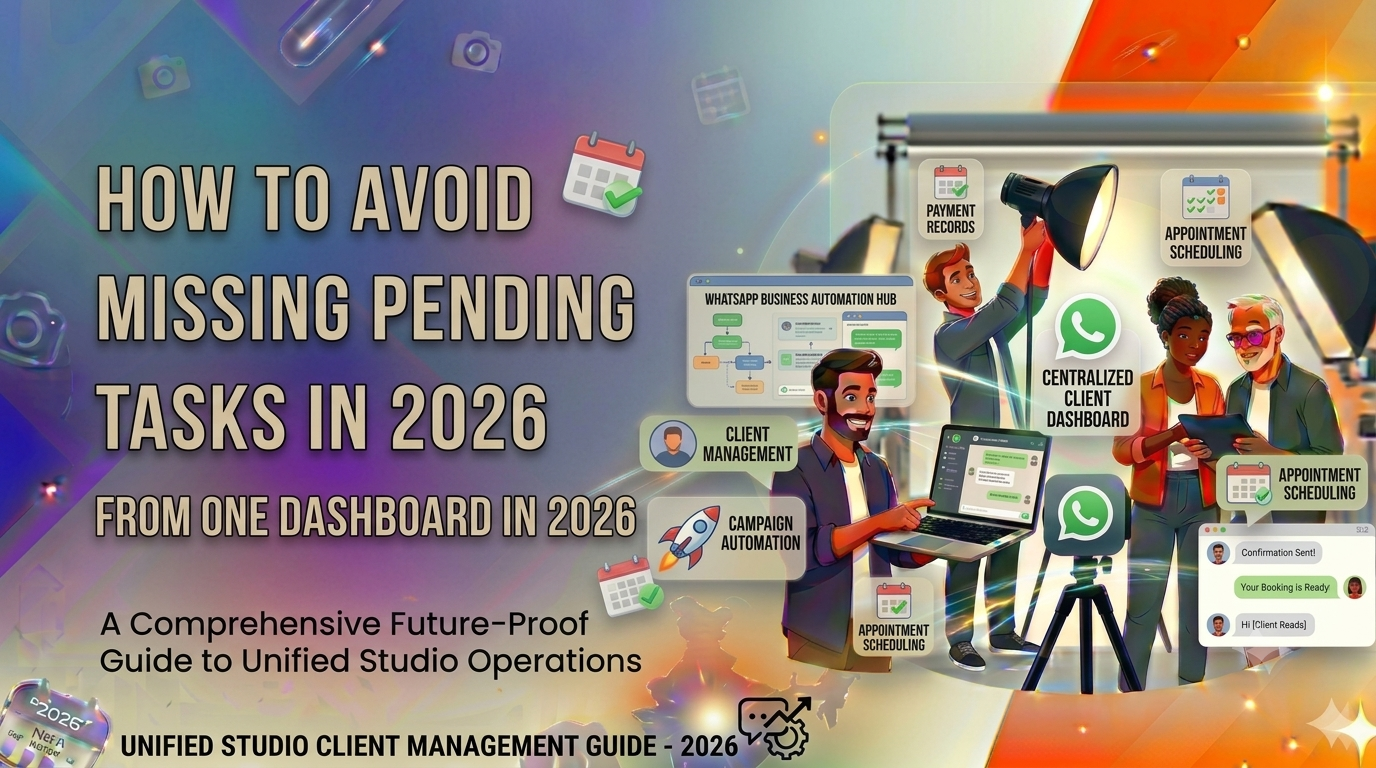
How to Avoid Missing Pending Tasks in 2026: A Photography Studio Guide
1. The Landscape of Indian Photography Studios in 2026
The photography industry in India has experienced an unprecedented evolution over the last few years. Driven by high-definition social media demands, destination weddings across premium locations like Jaipur, Udaipur, and Goa, and highly corporate brand requirements in hubs like Pune and Ahmedabad, the modern studio is no longer just a creative workshop. It operates as a high-volume enterprise. According to market insights highlighted by Statista, consumer spending on mega-events and luxury personal branding in India has risen exponentially, placing tremendous pressure on creative vendors to deliver flawless quality on accelerated schedules.
To remain competitive and profitable, studio owners must look past basic creative skills and establish absolute mastery over their operational backends. When handling twenty weddings, thirty corporate headshot profiles, and multiple commercial brand shoots simultaneously, human memory becomes an unreliable system. Learning how to avoid missing pending tasks in 2026 is the fundamental line separating highly profitable studios from those burdened by negative reviews, delayed album deliveries, and lost profits due to broken agreements.
2. Why Traditional Task Management Fails Modern Studios
For decades, standard photography setups relied on handwritten diaries, sticky notes pasted on editing monitors, or unorganized WhatsApp groups with freelance editors. In 2026, these fragmented channels are an operational liability. When a client from Surat sends a message regarding photo corrections on a casual chat, while another corporate client requests an updated quotation via email, information silos develop instantly. Without centralized monitoring, creative teams experience intense collaborative gaps, leading to severe project delays.
Furthermore, manual workflows fail to account for dependencies. For example, a cinematic video editor cannot begin sorting footages until the second shooter uploads the raw backup data to the local server. If the upload task is delayed and not explicitly tracked, the entire delivery pipeline collapses. Relying on memory or decentralized messaging structures causes miscommunication, unbilled client revisions, and extended wait times that severely tarnish a studio's professional reputation in a highly competitive market.
3. The Framework to Avoid Missing Pending Tasks
Establishing Bulletproof Operational Pipelines
To build an environment where no client requirement goes unnoticed, studio leads must structure their workflows using a comprehensive step-by-step framework. This framework moves a project seamlessly from the initial lead capture to the final archive phase without relying on the physical presence of the business owner. By creating distinct operational pipelines for client onboarding, main-day production logistics, and post-event asset delivery, responsibilities become clearly visible to every team member involved.
Leveraging Studio Automation and Proactive Alerting
The core pillar of an optimized workflow is automation. Instead of manually reviewing calendar logs to check if a pre-wedding edit is ready, modern studio owners rely on automated task generation engines. When a new event booking is confirmed on the clickdesk.in homepage, the management tool should instantly map out a pre-configured template of actions. This includes auto-assigning tasks such as sensor cleaning protocols, hard drive formatting, crew allocation sheets, and advance payment confirmation reminders.
Implementing WhatsApp Integration for Photography Studio Workflows
In the context of the Indian consumer ecosystem, emails often remain unread in spam folders, while WhatsApp maintains an exceptionally high open and response rate. Integrating automated notifications via WhatsApp ensures that your internal crew and your clients remain instantly aligned. Your primary photographers receive instant notifications regarding event venue shifts, while clients receive timely links to complete their selections. Discover how maximizing a dedicated WhatsApp integration for photography studio communication bridges the gap between active production tracking and seamless client satisfaction.
4. Streamlining Post-Production Tracking and Delivery Pipelines
The post-production stage is traditionally where a studio's efficiency faces its heaviest breakdown. While shooting an event is highly engaging, the subsequent weeks spent on culling thousands of raw images, performing meticulous color grading, and designing heavy wedding albums can easily result in severe backlogs. A lack of structure leads to internal team confusion regarding which projects are overdue or awaiting final approval from the client.
Managing Freelancers and In-House Editing Teams Successfully
Many growing studios hire external freelance editors or cinematic colorists to handle the intense workload during peak seasons. Without clear administrative controls, managing these assets can become highly chaotic. Studio owners must utilize structured assignment portals that restrict access to sensitive client data while tracking individual designer progress, milestones, and specific target dates. Utilizing dedicated software modules for team management for photography studio teams allows administrators to delegate edit batches, assess performance quality, and prevent unauthorized file transfers.
Optimizing the Complete Post-Event Lifecycle
A standardized post-production lifecycle must explicitly map out each critical stage of the media pipeline. The process involves systematically tracking raw media backups, culling progress, intensive retouching routines, and final client validation. Studios must configure dedicated systems optimized for post-production for photography studio operations to monitor progress dynamically across multiple projects. This prevents data bottlenecks and ensures editing timelines remain completely on track.
Streamlining Lead Nurturing and Client Order Management
Ensuring operational accuracy starts long before the actual event day. From the moment a prospective client submits an inquiry regarding packages, the studio must maintain a detailed, step-by-step history. Mismanaged follow-ups or ambiguous project definitions create confusion that impacts later production stages. Implementing clear order conversion for photography studio workflows ensures that all finalized package components, client expectations, and custom timeline terms are documented perfectly from day one. This keeps sales and creative delivery teams aligned seamlessly.
5. Integrating Payment Milestones and GST Compliance Invoicing
Operational task management is directly tied to a studio's financial health. A creative task is not truly completed until the associated financial milestone is cleared, an official invoice is rendered, and tax balances are recorded accurately. Failing to track outstanding payments properly results in critical revenue leaks that limit business growth.
Handling Complex Invoicing and Indian Tax Parameters
Operating a registered business in states like Gujarat, Maharashtra, or Rajasthan requires strict adherence to corporate tax guidelines established by the Goods and Services Tax (GST) Council. Every booking advance or final settlement must be documented with correct CGST and SGST or IGST breakdowns. Generating these details on manual templates often introduces calculation errors. Studios must adopt integrated billing systems that auto-calculate tax rules instantly, ensuring absolute transparency during seasonal audits.
Tracking Retainers and Milestone Payments Smoothly
Indian wedding contracts usually follow a split payment structure: 40% as an initial booking retainer, 40% on the main event day, and the remaining 20% during album delivery. If your team delivers the physical album before collecting the final payment, recovering that balance can become extremely difficult. Utilizing automated payment tracking for photography studio solutions ensures that delivery tasks are locked automatically until the platform confirms receipt of the outstanding balance through secure gateways like Razorpay or PayU. This protects your cash flow and reduces manual overhead.
Simplifying Estimates, Proposals, and Financial Reporting
Before an invoice is ever generated, a studio must present professional, clear quotes to prospective clients. Ambiguous itemizations often lead to scope creep, where clients demand extra services without additional payment. Utilizing formalized quotation management for photography studio platforms guarantees that all terms, addition fees, and payment structures are explicitly agreed upon digitally. Furthermore, evaluating overall business health requires continuous observation of operational margins. Using robust reporting tools for photography studio operations provides owners with accurate visual data on monthly revenue, pending client collections, and team productivity scores.
6. Digital Workflows vs. Manual Tracking Systems
Many studio managers continue to hesitate when upgrading from manual registers or standard spreadsheets, concerned about the learning curve or initial setup effort. However, evaluating the operational differences reveals that relying on outdated methods limits scalability and risks long-term business growth. Research by global management firms like McKinsey & Company emphasizes that automating repetitive tasks reduces corporate operational errors by over 35%, helping teams redirect focus toward high-value creative work.
The following table outlines the operational differences between manual tracking methods and modern digital workflow solutions:
| Operational Metric | Manual Methods (Registers, Excel) | Modern Dedicated Studio Software |
|---|---|---|
| Data Synchronization | Delayed. Team members must update spreadsheets manually. | Instant. Cloud infrastructure updates tasks in real time. |
| Payment Follow-ups | Manual calls or tracking text messages individually. | Automated WhatsApp/SMS notifications with payment links. |
| Tax & GST Calculations | High risk of calculation errors. | Automated invoice calculations for CGST, SGST, and IGST. |
| Freelancer Tracking | Difficult to trace via unorganized group chats. | Secure individual dashboards with monitored deadlines. |
| Client Feedback Capture | Scattered across handwritten notes and phone logs. | Centralized digital selection portals with automated tracking. |
To highlight the practical benefits of this transition, let us examine a standard post-production timeline for a three-day destination wedding shoot with a total contract value of ₹3,500,000:
| Workflow Stage | Manual Tracking Timeline | Automated Studio Software Timeline | Time Saved / Operational Impact |
|---|---|---|---|
| Raw Media Backup & Sort | 4-5 Days (Awaiting crew updates) | 1 Day (Instant dashboard upload confirmation) | Reduces data loss risks significantly |
| Client Selection Phase | 15-20 Days (Scattered messages) | 4 Days (Automated client reminder alerts) | Accelerates project velocity by 75% |
| Color Grading & Retouching | 25-30 Days (Freelancer delays) | 10 Days (Strict internal alert system triggers) | Maintains high customer satisfaction |
| Final Billing & GST Invoicing | 3 Days (Manual tax compilation) | Instant (Auto-generated compliant invoice) | Ensures zero tax penalties |
7. Eliminate Chaos with ClickDesk Studio Management Software
ClickDesk is an all-in-one photography studio management platform built specifically for Indian photography studios, creative agencies, and independent production houses. Developed to replace fragmented tools, ClickDesk consolidates customer relationships, project pipelines, financial tracking, and team scheduling into a unified workspace. It empowers studio owners across India to gain absolute control over daily business operations, transition smoothly away from chaotic manual tracking, and ensure they never miss critical pending tasks again.
The platform provides specialized features tailored directly to the unique operational and legal demands of the Indian creative market:
- Automated Task & Event Templates: Instantly deploy tailored production plans for multi-day regional weddings, commercial assignments, or portrait sessions.
- Indian Tax & GST Invoicing: Auto-generate compliant invoices detailing CGST, SGST, and IGST components effortlessly, minimizing accounting errors.
- Native WhatsApp & SMS Reminders: Send automated booking updates, raw file selection links, and custom project status changes directly to your client's smartphone.
- Integrated Payment Gateway Support: Link your outstanding invoices with reliable payment processors like Razorpay and PayU to collect client deposits securely.
- Granular Contractor Access: Delegate tasks securely to freelance retouchers, videographers, and album designers without exposing sensitive internal business data.
- Advanced Business Analytics: Track outstanding studio balances, evaluate individual employee performance metrics, and review end-of-month profit statements instantly.
Explore the complete capabilities of the system by visiting the best feature for photography studio management software feature breakdown page. To find the right plan for your business growth, view our flexible options on our studio software pricing plans page today.
Take complete control of your creative business operations, eliminate delivery backlogs, and secure your hard-earned revenue. Explore our updates and industry strategies directly through our photography studio business blog for more professional growth insights.
Ready to experience effortless project organization, automated client notifications, and error-free tax invoicing? Transition your creative workspace into an organized, high-efficiency system. Start your free ClickDesk trial today →
8. Frequently Asked Questions (FAQ)
What is the most effective way to organize multi-day wedding shoots without losing track of details?
Organizing multi-day events successfully requires breaking down each distinct day (such as Haldi, Sangeet, and Reception) into its own sub-project. Utilizing an advanced tool like ClickDesk allows you to assign specific team members, track backup progress for individual memory cards, and schedule automated follow-ups for each production phase, ensuring no detail is overlooked.
Can I configure custom GST billing rules for clients located in different states?
Yes, professional studio management solutions allow you to establish automated tax rules based on your client's location. The system applies local CGST and SGST for intra-state bookings automatically, or switches to IGST parameters for destination weddings outside your home state, keeping your studio legally compliant without manual calculations.
How does automated WhatsApp communication improve the overall client review process?
Instead of sending file selection links through emails that clients often miss, automated systems deliver access links directly via WhatsApp. This ensures rapid visibility, allows clients to select images comfortably on their phones, and automatically reminds them of upcoming review deadlines, preventing delays in your post-production pipeline.
Is it possible to manage external freelance editors without sharing confidential studio financial data?
Yes. Platforms like ClickDesk offer granular access control features. This allows you to invite external freelance designers or editors to view only the specific media assets and production deadlines assigned to them, while completely hiding sensitive business metrics, main contracts, and client payment histories.
What happens if a client delays their scheduled milestone payments during a project?
Integrated tracking tools mitigate payment delays by triggering automated SMS and WhatsApp reminders containing secure payment links (via gateways like Razorpay or PayU) as deadlines approach. Additionally, studios can configure workflows that pause active editing or album design tasks automatically until the outstanding milestone balance is cleared.